

Week day abbreviations are standardized shortened forms of the seven calendar days, most commonly rendered in three-letter (Mon, Tue, Wed), two-letter (Mo, Tu, We), or single-letter (M, T, W) formats. These compact codes save critical space on digital calendars, shift rosters, contract deadlines, and database structures. Knowing which convention to use keeps your schedules readable and prevents costly timing mix-ups in professional workflows.
When building schedules or mapping project timelines, a quick sanity check using a day of the week calculator removes any guesswork about which calendar date matches your target abbreviation.
What are the standard week day abbreviations in English?
The primary standard for week day abbreviations in English relies on three-letter truncations: Mon, Tue, Wed, Thu, Fri, Sat, and Sun. These forms are universally recognized across publishing platforms, digital software, and business communications.
Depending on screen space or system layout, shorter variants exist to fit compact UI components and print calendars. The chart below lays out the complete standard list across all common formats.
| Day of the Week | 3-Letter (Standard) | 2-Letter (Compact) | 1-Letter (Minimal) | ISO 8601 Numeric |
|---|---|---|---|---|
| Monday | Mon | Mo | M | 1 |
| Tuesday | Tue | Tu | T | 2 |
| Wednesday | Wed | We | W | 3 |
| Thursday | Thu | Th | R (or Th) | 4 |
| Friday | Fri | Fr | F | 5 |
| Saturday | Sat | Sa | S | 6 |
| Sunday | Sun | Su | U (or Su) | 7 |
Three-letter abbreviations offer the best balance between clarity and brevity. I always recommend using three-letter codes whenever layout room allows, as they eliminate the risk of misinterpretation.

When should you use 2-letter vs 3-letter weekday abbreviations?
You should use 3-letter weekday abbreviations for standard documentation and 2-letter abbreviations when horizontal grid space is tightly constrained. Three-letter codes function best in formal body copy, table headers, and email updates where instant readability is essential. Two-letter codes suit compact mobile widgets, print calendar headers, and narrow data spreadsheets.
Style guides dictate specific context rules for shortening day names:
- Publication Style: The Associated Press Stylebook recommends spelling out days of the week fully in news text, restricting abbreviations to tabulations and dense lists.
- Interface Design: According to guidelines from the Unicode Consortium CLDR, software localization uses "abbreviation days of the week" sets specifically tuned for narrow viewports (such as two-letter headers on smartphone calendar views).
- Database Formatting: Standard SQL and reporting interfaces default to three-letter codes (e.g.,
DYformat in Oracle orMonin PostgreSQL) to preserve fixed-width alignment across columns.
If you are setting up repeating business workflows or counting working windows, running your start and end dates through a business days calculator prevents manual calendar mistakes before you publish team rosters.
Why do single-letter day abbreviations create scheduling confusion?
Single-letter day abbreviations create confusion because Tuesday and Thursday both start with "T," while Saturday and Sunday both start with "S." When a schedule simply reads "T," the reader cannot tell if an event happens on Tuesday, Thursday, or both.
To solve this duplicate letter issue, organizations adopt alternative single-character conventions:
- The Academic Convention (M-T-W-Th-F): Universities and course catalogs use "Th" for Thursday and "Su" for Sunday while keeping single letters for the rest.
- The "R" and "U" Code System: Higher education registration systems often assign R to Thursday (to distinguish it from T Tuesday) and U to Sunday (to distinguish it from S Saturday).
- Two-Letter Fallback (Mo-Tu-We-Th-Fr-Sa-Su): Shift work systems abandon single letters entirely in favor of strict two-letter pairs to eliminate ambiguous letters.
I'd skip single-letter codes entirely for external business deadlines or client contracts. The few saved pixels are never worth the risk of someone missing a Thursday meeting because they thought "T" meant Tuesday.
How do technical systems and databases encode days of the week?
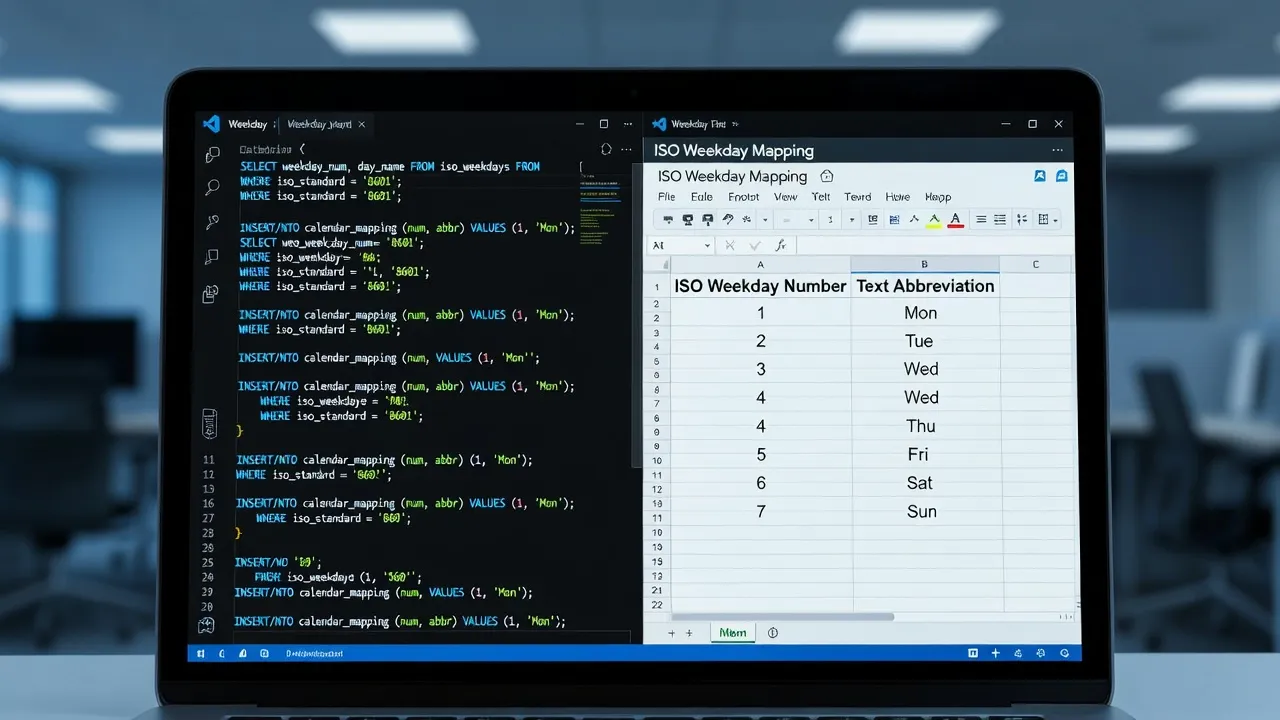
Technical systems encode days of the week using international standards like ISO 8601 or system-specific numerical indexes from 1 to 7. Rather than storing text strings like "Monday" or "Mon," databases store numbers to simplify sorting, filtering, and internationalization.
The official ISO 8601 standard establishes Monday as day 1 and Sunday as day 7. However, legacy software formats often deviate from this standard:
- ISO 8601 Standard: 1 = Monday, 2 = Tuesday, ..., 7 = Sunday.
- US System Default (Excel/POSIX): 1 = Sunday, 2 = Monday, ..., 7 = Saturday (though functions allow remapping).
- Cron Jobs (Linux Scheduler): 0 or 7 = Sunday, 1 = Monday, ..., 6 = Saturday.
When building spreadsheet models that calculate dates across formulas, referencing structured tables or specialized guides like our Date Calculator Excel guide keeps your date math consistent across system boundaries.
How do you handle weekday abbreviations in business contracts and deadlines?
In formal business contracts, weekday abbreviations should always be paired with the full calendar date (e.g., "Fri, Nov 13, 2026") or omitted in favor of the full day name. Using an ambiguous abbreviation like "T" or "S" in a contract creates legal uncertainty regarding exact deadline enforcement.
As of October 2026, standard corporate compliance guidelines emphasize three primary rules for scheduling legal notices:
- Always Include the Full Year: Write "Mon, Oct 12, 2026" rather than simply "Mon 10/12".
- Spell Out Days in Legal Terms: Use "Friday" instead of "Fri" in core contract clauses to prevent typographical disputes.
- Define Business Day Exclusions: Explicitly state whether deadlines landing on "Sat" or "Sun" automatically roll over to "Mon".
RECOMMENDED CONTRACT FORMATS:
- Clear: "The notice period expires on Friday, November 20, 2026."
- Acceptable (Tables): "Fri, Nov 20, 2026"
- Risky: "Due on T, 11/20" (Ambiguous day and format)
What are the international weekday abbreviation standards?
International weekday abbreviations depend on language-specific locale codes managed by Unicode standards. While English relies on "Mon-Sun," other languages use entirely different multi-letter or single-letter stems derived from their native vocabulary.
The Unicode Common Locale Data Repository (CLDR v44+) defines standardized short and narrow forms across global languages:
- Spanish: Lun, Mar, Mié, Jue, Vie, Sáb, Dom (Narrow: L, M, X, J, V, S, D - where "X" replaces Miércoles to avoid double "M").
- French: Lun, Mar, Mer, Jeu, Ven, Sam, Dim (Narrow: L, M, M, J, V, S, D).
- German: Mo, Di, Mi, Do, Fr, Sa, So (Narrow: M, D, M, D, F, S, S).
If you manage remote teams or international client schedules, verifying timezone offsets and regional date formats prevents miscommunication when setting up global meetings.
Frequently Asked Questions
What is the 2-letter abbreviation for Thursday?
The standard 2-letter abbreviation for Thursday is Th. Some software systems use Tu for Tuesday and Th for Thursday to prevent confusion.
What is the 3-letter abbreviation for Tuesday?
The official 3-letter abbreviation for Tuesday is Tue. Some older style guides occasionally used Tues, but Tue is the universal standard in modern software and publishing.
Why is Thursday sometimes abbreviated as "R"?
Thursday is abbreviated as "R" in academic schedules and university registration systems to distinguish it from Tuesday ("T") when using single-letter codes.
Why is Sunday sometimes abbreviated as "U"?
Sunday is abbreviated as "U" in single-character scheduling codes to avoid confusion with Saturday, which uses "S".
Is Wednesday abbreviated as "Wed" or "Weds"?
Wednesday is standardly abbreviated as Wed in international, business, and software standards. Weds is an informal written variant used mostly in casual note-taking.
What is the ISO number for Monday?
Under the ISO 8601 standard, Monday is designated as day 1 of the calendar week, running sequentially through Sunday as day 7.
How do you abbreviate weekdays on calendar headers?
Calendar headers typically use 1-letter codes (M, T, W, T, F, S, S) or 2-letter codes (Mo, Tu, We, Th, Fr, Sa, Su) depending on how much width is available per column.